
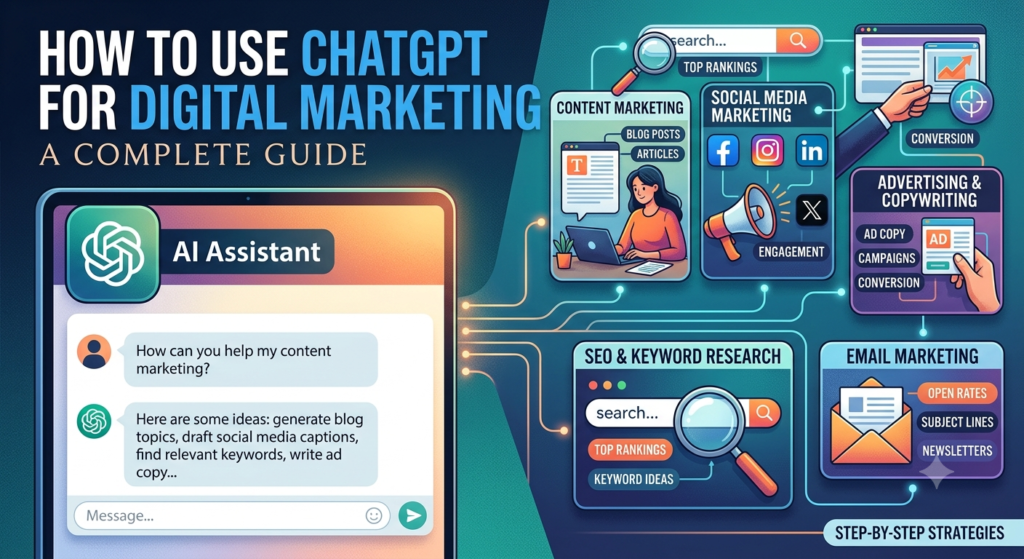
Digital marketing is constantly changing. Businesses today need to create high-quality content, engage with customers, manage social media, improve search rankings, and generate leads—all while working with limited time and resources.
This is where artificial intelligence tools such as ChatGPT can make a significant difference.
ChatGPT can help digital marketers brainstorm ideas, write content, research audiences, create social media posts, develop email campaigns, improve ad copy, and automate many repetitive tasks. However, it works best as a marketing assistant rather than a complete replacement for human creativity and strategy.
In this guide, we’ll explore how to use ChatGPT for digital marketing and how businesses can get better results from it.
What Is ChatGPT?
ChatGPT is an AI-powered conversational tool that can understand instructions and generate human-like text. Marketers can use it for a wide range of tasks, from creating content ideas to developing marketing strategies.
Instead of starting every task from scratch, marketers can give ChatGPT a clear prompt and use its response as a starting point.
For example, instead of asking:
“Write a blog.”
You could provide more context:
“Create a 1,500-word blog outline about digital marketing for small businesses. Include an introduction, five main sections, practical examples, and a conclusion. Use a clear and beginner-friendly tone.”
The more specific your instructions are, the more useful the output is likely to be.
1. Generate Blog Topic Ideas
Coming up with fresh content ideas can be challenging, especially when you publish regularly. ChatGPT can help you generate dozens of potential topics based on your industry, target audience, and goals.
For example, a digital marketing agency could ask ChatGPT:
“How to Do Local SEO for a Small Business in 2026
You can then ask it to turn the best ideas into content clusters.
For example:
- SEO basics
- Keyword research
- Local SEO
- Technical SEO
- Link building
- SEO analytics
This approach can help you build a more organized content strategy instead of publishing unrelated articles.
2. Create Blog Outlines
Once you have a topic, ChatGPT can help structure your article.
A good prompt might be:
“Create a detailed outline for a 1,500-word article titled ‘How to Improve Local SEO for a Small Business.’ Include an introduction, H2 and H3 headings, practical tips, examples, and a conclusion.”
The resulting outline can provide a logical structure before you begin writing.
However, don’t publish AI-generated content without reviewing and refining it first. Add your own experience, examples, data, opinions, and insights to make the article genuinely useful.
3. Improve SEO Content
ChatGPT can assist with many parts of an SEO workflow.
You can use it to brainstorm:
- Primary and secondary keyword ideas
- Blog titles
- Meta descriptions
- FAQ questions
- Subheadings
- Internal linking ideas
- Content briefs
- Search-intent variations
For example, you could ask:
“Create 10 SEO-friendly blog titles for the keyword ‘social media marketing for small businesses.’ Keep each title natural and appealing to readers.”
ChatGPT can also help rewrite awkward sentences and make content easier to understand.
Keep in mind that SEO is more than inserting keywords into an article. Search intent, useful information, website quality, authority, user experience, and originality all matter. AI should support your SEO strategy rather than replace it.
4. Create Social Media Content
Managing multiple social media platforms can be time-consuming and challenging ChatGPT can help marketers create first drafts for posts across platforms such as Instagram, Facebook, LinkedIn, and X.
For example:
“Write five LinkedIn posts for a digital marketing agency targeting small business owners. Use a professional but friendly tone. Each post should provide one practical marketing tip.”
You can also ask ChatGPT to adapt the same idea for different platforms.
A long-form blog post could become:
- A LinkedIn post
- An Instagram caption
- A Facebook post
- A short video script
- Several X posts
- An email newsletter
This process, known as content repurposing, allows marketers to get more value from existing content.
5. Write Better Email Campaigns
Email marketing is another area where ChatGPT can save time.
Marketers can use it to draft:
- Welcome emails
- Promotional emails
- Newsletters
- Product announcements
- Abandoned-cart messages
- Follow-up emails
- Customer re-engagement campaigns
For example:
“Write a friendly promotional email for an online fitness business offering 20% off its annual membership. Include a strong but natural call to action.”
You can then ask ChatGPT to create multiple versions with different tones.
For example, one version could be professional, another conversational, and another focused on urgency.
Always review email copy before sending it to customers. Your brand voice should remain consistent, and promotional claims should be accurate.
6. Create Advertising Copy
Digital advertising requires concise and persuasive messaging. ChatGPT can help generate different variations of headlines, descriptions, calls to action, and ad concepts.
For example:
“ Keep them clear, benefit-focused, and suitable for search advertising.”
Instead of relying oCreate 15 compelling and attention-grabbing advertising headlines for a local web design company targeting small businesses. Focus on attracting new customers, building a professional online presence, increasing website traffic, and generating more leads. n a single piece of copy, marketers can create several variations and test them.
The important point is that ChatGPT can help with ideation and drafting, but actual advertising performance should be measured using real campaign data.
7. Understand Your Target Audience
Successful marketing starts with understanding your audience.
ChatGPT can help you organize information about your ideal customers and develop buyer-persona frameworks.
For example:
“Create a buyer persona for a small-business owner looking for affordable digital marketing services. Include their goals, challenges, concerns, buying motivations, and common questions.”
You can use these insights to brainstorm content and marketing messages.
However, AI-generated personas should not be treated as actual customer research. Real customer interviews, surveys, analytics, reviews, and sales conversations provide stronger evidence.
Use ChatGPT to organize and explore ideas—not to replace real-world research.
8. Generate Video and Podcast Ideas
Video marketing has become an important part of digital marketing. ChatGPT can help marketers develop ideas for YouTube videos, short-form videos, webinars, and podcasts.
For example:
“Give me 20 short-form video ideas for a digital marketing agency targeting restaurant owners. Each idea should address a common marketing problem.”
You can then ask ChatGPT to turn one idea into a script.
It can help create:
- Video hooks
- Talking points
- Scripts
- Titles
- Descriptions
- Calls to action
- Frequently asked questions
This can make the content-production process much faster.
9. Analyze and Improve Existing Content
ChatGPT isn’t only useful for creating new content. It can also help you improve content you already have.
You can provide a piece of writing and ask for suggestions related to:
- Readability
- Structure
- Tone
- Clarity
- Grammar
- Repetition
- Calls to action
- Audience suitability
For example:Review this landing-page copy from the perspective of a small-business audience. Identify unclear or confusing sections, repetitive content, weak messaging, and opportunities to strengthen the value proposition, improve readability, and make the copy more persuasive.
10. Build a Complete Content Strategy
. one of the most powerful ways to use ChatGPT is to combine individual tasks into a broader marketing workflow.
For example, you can ask ChatGPT to help create a 30-day content plan based on your business goals.
A prompt could be:
“Create a detailed 30-day digital marketing content calendar for a small e-commerce business. Include daily content ideas, suitable platforms, content formats, engaging captions or topics, relevant calls to action, and goals focused on increasing brand awareness, website traffic, engagement, and sales. You can then refine the plan based on your actual products, customers, budget, and marketing channels.
This gives you a starting framework that you can adjust as you learn what works.
Best Practices for Using ChatGPT in Digital Marketing

Getting valuable results from ChatGPT largely depends on how clearly you communicate with the AI. Instead of using short or vague instructions, provide relevant context, specific goals, your target audience, and the desired format or tone. The more detailed and precise your prompt is, the more useful and relevant the response is likely to be.
A strong prompt should explain:
Role: Who should ChatGPT act as?
Task: What do you want it to produce?
Audience: Who will read or use the content?
Tone: Should it be professional, friendly, persuasive, educational, or casual?
Format: Do you want a blog outline, table, social post, email, or script?
Goal: What action should the audience take?
For example:
“Act as a content strategist. Create a 1,500-word blog outline about email marketing for small businesses. The audience is beginners with limited marketing experience. Use a practical and friendly tone. Include examples, actionable tips, and a conclusion with a clear call to action.”
This is much more effective than simply asking, “Write about email marketing.”
What Are the Limitations of ChatGPT
Although ChatGPT can be extremely useful, marketers should understand its limitations.
AI-generated content may contain mistakes, outdated information, generic statements, or claims that need verification. It may also lack the personal experience and unique perspective that make content stand out.
For this reason, marketers should always review important content before publishing it.
Fact-check statistics, verify claims, add original insights, and make sure the final content accurately represents your brand.
The goal shouldn’t be to produce the maximum amount of AI-generated content. The goal should be to use AI to create better marketing more efficiently
Final Thoughts
ChatGPT can become a valuable assistant for digital marketers. From brainstorming blog topics and creating social media content to writing email campaigns and developing content strategies, it can reduce the amount of time spent on repetitive tasks.
The best results come when AI and human expertise work together.
Use ChatGPT for ideas, research assistance, outlines, drafts, variations, and optimization. Then bring your own experience, creativity, data, brand knowledge, and judgment to the final product.
In other words, don’t let ChatGPT replace your marketing strategy. Use it to make your strategy faster, more creative, and more efficient.
As digital marketing continues to evolve, learning how to use AI tools effectively can give businesses and marketers a valuable advantage